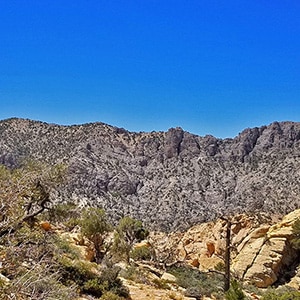
Overview | Upper Crest Ridgeline: Hidden Peak to Hwy 160 | Rainbow Mountain Wilderness, Nevada
Rainbow Mountains as Seen from Red Rock Canyon National Conservation Area
The spectacular view of tall Jurassic Aztec Red Rock peaks along the Western border of
Red Rock Canyon National Conservation Area and stretching South all the way to
Potosi Mountain is familiar to all Red Rock Canyon National Conservation Area visitors. The most recognizable peaks include
Bridge Mountain,
Juniper Peak and
Rainbow Mountain. The best known additional peaks further South include
Mt. Wilson,
Indecision Peak and
Windy Peak. Together, these mountains make up their own unique wilderness area adjoining
Red Rock Canyon:
The Rainbow Mountain Wilderness.
More Accurate Listing of Major Peaks in the Rainbow Mountains
In the video of my first adventure on the Southern ridgeline, I was encountering the
Rainbow Mountain Peaks below and attempting to number and identify them. Here is a more definitive description of the peaks following my later research. The peak numbers match the numbers in the video, but here are the names and position of the peaks from South to North, beginning from the
Mountain Springs Trailhead:
Gap Peak
South Peak
Hollow Rock Peak
Windy Peak
Global Peak (Sprouts from the Northeastern Base of
Windy Peak)
Black Velvet Peak
Mountain Springs Peak (between
Black Velvet Peak and
Hidden Peak) Unlike the others, is on the high ridgeline.
Hidden Peak
Monument Peak Further Out East, Higher
Sandstone Peak: The low, long peak between
Hidden Peak and
Indecision Peak
Indecision Peak
Mt. Wilson
Rainbow Mountain
Juniper Peak
Bridge Mountain
North Limestone Peak: Above
Bridge Mountain and a bit further North on the Ridgeline
North Sandstone Peak
There are additional peaks below the ridgeline, but these (above) are some of the main peaks. The links lead to the summit adventures (each with Slide Guide, Map Guide, Video Guide and Narrative Guide). Most descend to the summits from the
Rainbow Mountains Upper Crest Ridgeline above.
Ascending the Rainbow Mountains
Most people who ascend the
Peaks of The Rainbow Mountain Wilderness do so from the base of the peaks in
Red Rock Canyon NCA.
However, there is another approach route to the peaks…from above! There is a ridgeline that extends above the upper edge of the
Rainbow Mountains. Not having found an official name for this ridgeline, we’ll call it The
Rainbow Mountains Upper Crest Ridgeline. Potentially, one could
descend from the upper ridgeline to the summit of the peaks in the
Rainbow Mountain Wilderness. In fact, the customary summit of
Bridge Mountain is such a route. In many cases, descent from the upper ridgeline is less technical than ascent from below. However, the distance involved in getting to the upper ridgeline in order to descend to the peaks is the challenge to this approach. But for a trail runner who is not a technical rock climber (at least much beyond class 3 difficulty level), descent from the upper ridgeline may be the ideal solution.
North Peak on the Rainbow Mountains North Upper Crest Ridgeline
By the way, one additional peak creates a high point on the ridgeline itself: The non-Jurassic, non-red rock
North Limestone Peak.
North Limestone Peak rests on the ridgeline roughly above
Bridge Mountain. On the
North Limestone Peak page of this website I describe traversing the Northern portion of The
Rainbow Mountains Upper Crest Ridgeline from
Rocky Gap Road to
Bridge Mountain.
Summary Assessment of the Ridgeline
This adventure involves scoping out the Southern portion of the
Rainbow Mountains Upper Crest Ridgeline, documenting the well-known peaks along with the more obscure peaks in the
Rainbow Mountain Wilderness, and viewing potential summit approaches to each peak. We take the ridgeline from its Southern end near
Mountain Springs Trailhead on
Hwy 160 to the 5th Rainbow Mountain peak,
Hidden Peak, where a large gap begins in the ridgeline with a substantial descent before the ridgeline again rises above
Indecision Peak and
Mt. Wilson, then continues North.
There are actually 3 approaches to The Rainbow Mountains Upper Crest Ridgeline:
- Northern approach from Rocky Gap Road at the Willow Springs trailhead area in Red Rock Canyon. See also the page on Bridge Mountain.
- Mid-ridge approach from Rocky Gap Road in Lovell Canyon.
- Southern approach from the Mountain Springs trailhead off Hwy 160 at Potosi Mountain
Directions to the Start Point | Upper Crest Ridgeline: Hidden Peak to Hwy 160 | Rainbow Mountain Wilderness, Nevada
Getting to Mountain Springs Trailhead
Take
I-215 to the
Charleston Blvd. Exit in
Summerlin, then head upward toward
Red Rock Canyon. Pass
Red Rock Canyon, continuing on
Hwy 159. Pass the town of
Blue Diamond, then turn right onto
Hwy 160 toward
Pahrump.
Hwy 160 will ascend upward to a high point just before the town of
Mountain Springs. Around that high point park at the
Mountain Springs Trailhead on your right. The trailhead has no marking and is a hard right turn off
Hwy 160 onto an unpaved road and into an area that looks like an unimproved campground with scattered areas to park. If you are the first to arrive in the morning and the parking area is empty, it’s not obvious that you are at a trailhead.
↓ Narrative Guide ↓
Narrative Guide | Upper Crest Ridgeline: Hidden Peak to Hwy 160 | Rainbow Mountain Wilderness, Nevada
Locating the Route to the Rainbow Mountains South Upper Crest Ridgeline Trail
Once you have successfully located the
Mountain Springs Trailhead, your next challenge is to locate the unmarked trail to the
Rainbow Mountains Upper Crest Ridgeline. The key now is the communications tower about 1/4th mile up the hill to the North from the parking area. The trail to the
Rainbow Mountains Upper Crest Ridgeline begins behind the communication tower.
2 Unpaved Road Approaches to the Trail Behind the Communication Tower
There are 2 unpaved roads heading North to the communication tower from the
Mountain Springs Trailhead area:
- The road to the right ends in a few hundred feet, but you can see the communication tower from that point and head cross-country on a faint use trail directly to the tower. This is the most direct route.
- The road to the left is the main road that winds around a bit and leads all the way to the communication tower. In about 100 yards, when that road splits take the right split up to the communication tower.
Navigating From the Communication Tower to the South Ridgeline
Once you reach the communication tower, ascending to the
Rainbow Mountains Upper Crest Ridgeline involves continuing around the gate at the tower to find the true beginning of the very good trail behind the tower. Now your point of reference is the
Rainbow Mountains Upper Crest Ridgeline you see to your right (Northeast). The trail will rise to the top of that ridgeline and continue above the rainbow mountains to the large break I call the
Mid Upper Crest Ridgeline Gap between
Hidden Peak and
Mt. Wilson. Yes, it’s a large break, but not impossible to navigate.
Hazy Morning on the Rainbow Mountains South Upper Crest Ridgeline
It was the last weekend in May, the morning temperature in the
Las Vegas Valley was about 70 degrees and predicted to reach 93 degrees. The morning temperature on the ridgeline was around 50 degrees and chilly. In my experience, for every 1000ft of elevation gain you loose 5 degrees temperature.
There must have been a fire somewhere because the sky was very hazy. My morning pictures and videos reflect this haze while the afternoon pictures and videos show crystal clear skies.
Hollow Peak on The Rainbow Mountains South Upper Crest Ridgeline
When I summited the ridgeline I first took a quick deviation South to the highest point on the very Southern end of the ridgeline. From this point one can descend to
Hollow Rock Peak and
South Peak.
South Peak is more a spur from the ridgeline than a distinct peak, though from below it looks more like a peak.
Windy Peak on The Rainbow Mountains South Upper Crest Ridgeline
Retracing my way to the point where I had summited the ridgeline I continued North. The ridgeline rose to another high point where there was a distinct right split-off trail to the right, marked by a cairn. This is the trail to
Windy Peak.
Windy Peak is perhaps the most popular peak off the Southern ridgeline. That adventure is already documented.
Global Peak: Very Steep, at the Base of Windy Peak
Once past
Windy Peak, I looked back and noticed a steep peak midway up the Northeastern base of
Windy Peak.
Global Peak is pretty vertical. Unless you’re an experienced rock climber you might consider it to be “
Impossible Peak”.
Black Velvet Peak: Another Major Spur Eastward off the Main Ridgeline North of Windy Peak
Black Velvet Peak, from above, looks composed of white rock and looks approachable. However, there are a few potential vertical barriers before the Eastern edge of the peak. We’ll scope that out in its own future adventure. The views are incredible, the traverse somewhat challenging and the trip well worth it.
High Point of the Southern Ridgeline: Mountain Spring Peak
The
Rainbow Mountains Upper Crest Ridgeline continues to rise. There are a number of elevation gains and losses on the ridgeline, some over 200ft. The overall elevation gain from the
Mountain Springs Trailhead to the highest point on the Southern ridgeline,
Mountain Spring Peak, is about 1000ft. However, you could easily double that elevation gain due to the rolling hills on the ridgeline, not to mention the additional elevation loss and gain every time you descended to one of the
Rainbow Mountain Peaks below the ridgeline.
Mountain Spring Peak is a deviation right (East) above the main trail and it affords a spectacular 360 degree view of the entire region including the ridgeline,
Potosi Mountain, Las Vegas,
Lake Mead and beyond, the
La Madre Mountains Wilderness,
Red Rock Canyon National Conservation Area, the
Mt. Charleston Wilderness,
Lovell Canyon and many more points of interest. Of course, on this morning when I summited
Mountain Spring Peak it was too hazy to see all of this, but I did catch these points of interest along the ridgeline on the return trip. There is a summit box on
Mountain Spring Peak. The summit box did not indicate the identity of the peak, which I discovered by later research.
Hidden Peak and Monument Peak: Terminus of the Main Southern Ridgeline Trail, Well Traveled
Beyond
Mountain Spring Peak the Ridgeline trail again sharply descends around 300ft, then rapidly ascends again. Along the upper length of the trail after the ascent there are some spectacular rock formations framing views to the East along with views of
Hidden Peak and
Monument Peak. As the main trail begins to take a sharp right and plunge downward toward
Hidden Peak, one can see a spur in the ridge that continues on North for about 1/2 mile before the ridge appears to end with a large gap before rising again around
Indecision Peak and
Mt. Wilson.
I continued on the main trail, taking the hard right plunge to
Hidden Peak.
Hidden Peak is distinctive,
Jurassic Era sandstone calico (red/white rock) and a true adventure in itself. The trail ended where the rock began, but there were a series of cairns that tended to appear and disappear at times. The key to
Hidden Peak is when you hit the rock, head Southeast along the edge of an obvious huge drop-off. Soon you’re angling South toward another large drop-off. You can see the peak to the Southeast and a saddle just West of the peak that provides a route to the summit. Head for that saddle and final summit approach. As you’re heading South, when you reach the great drop-off cliff, take a left (East) down to the base of the saddle.
Beyond the saddle there is an incline ridge leading toward the summit. You can take a route on the right (South) or left (North) side of the ridge, although it appears the North route is the most distinct. Cairns can be seen on both the North and South routes. I continued a bit further along the North route until I hit a brief class 4 section near the summit. You’ll likely make it all the way to the summit on your first trip, which I document in the
Hidden Peak adventure!