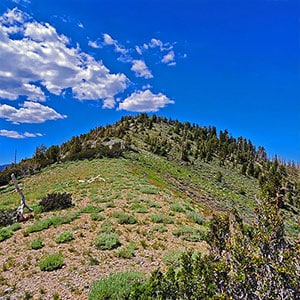
, on this day carpeted by wildflowers following an uncommonly wet Winter. Upon ascending
. Upon summiting
. In short, you’re seeing a good slice of the vast
wilderness and too many points beyond to list here.
I would normally recommend this adventure for an early Summer or early to late Fall day when the temperature in Las Vegas does not exceed 90 degrees. However, during this uncommonly wet Winter, snow lingered on the upper ridges into early June. So, I ended up doing this adventure on July 1st when the temperature in Las Vegas was predicted to reach 110 degrees! Yet, even on this day, a strategy kept me in the mid-70s for most of the adventure. The starting temperature at 6:30am was 56 degrees! Actually a bit cold. By the time I reached the base of
it was about 70 degrees. Upon ascending The Wilson Ridge and summiting Harris Mountain it was still 70-75 degrees! The descent back into Lovell Canyon may have reached into the mid 80’s, but not uncomfortably hot, and I was heading downhill, exerting less energy and heat.
I brought 5 liters of water. Heavy at first! In the end, only a half liter remained. You definitely do not want to run out of water during this adventure!
Route Start Point Directions | Wilson Ridge to Harris Mountain Summit, Nevada
Take Hwy 160 from
Las Vegas toward
Pahrump. The highway ascends over a “hump” (the
Potosi Mountain area). There’s a saying around here, “Over the hump to Pahrump”. Well, you’ve just traveled over that hump. Around 4-5 miles from the point where the highway begins to descend toward Pahrump there is a well-marked sign on the right for
Lovell Canyon Road. Proceed 12 miles to the upper end of
Lovell Canyon Road where there is a parking area.
↓ Narrative Guide ↓
Narrative Guide | Wilson Ridge to Harris Mountain Summit, Nevada
The Initial Stretch to the Base of Lovell Canyon
The initial stretch of this adventure, about 2.5 miles from upper
Lovell Canyon Road to the base of
Lovell Canyon, is the only stretch on roads and trails. The rest of the adventure is pure wilderness. Beginning at the upper end of
Lovell Canyon Road where it branches off to the unpaved
Lovell Summit Road (left turn), take L
ovell Summit Road a quarter mile to the upper
Lovell Canyon Campground and the
Lovell Canyon Trailhead. The
Lovell Canyon Trailhead will rapidly ascend to a beautiful view of upper
Lovell Canyon:
Wilson Ridge to the East,
Sexton Ridge to the West.
Scoping Out Your Adventure Route
This gives you a good summary of your adventure route. Notice the line of the old defunct
Harris Mountain Road spanning the slope of
Harris Mountain mid-way between the base of
Lovell Canyon and upper
Wilson Ridge. Notice where that road ends. Then notice a kind of level plateau stretch for about a quarter mile South from that point on
The Wilson Ridge. Your target ascent point will be the point on
The Wilson Ridge where that plateau area sharply descends. There is a nice approach ridge up to that point and an actually quarter-mile trail heading North along the plateau to the connection with
Harris Mountain Road. More on this later, but for now, just keep a focus on the ascent point to the
Wilson Ridge.
Lovell Canyon Wash
Stay on The
Lovell Canyon Trail until it empties into
Lovell Canyon Wash. There is only one trail fork before the trail reached
Lovell Canyon Wash. Take the right fork down into
Lovell Canyon. The left fork would take you up to
Griffith Shadow Loop. That’s the fork you take if your goal is
Sexton Ridge. Not today! Keep right to descend into The
Lovell Canyon Wash.
Noting the Location of The Lovell Canyon Trail for Your Return Trip
Note the point where The
Lovell Canyon Trail meets
Lovell Canyon Wash. There is a rocky outcrop there. You’ll need to focus on that rocky outcrop to find The
Lovell Canyon Trail on your return trip. Why? During your return you will be descending the far side (East side) of the wash and the only indication of where to turn, cross the wash and re-connect with The
Lovell Canyon Trail will be that rocky outcrop. If you miss it you will be continuing down
Lovell Canyon to a barrier fence at the
Torino Ranch. How I know this? I once did it! Squirmed under the fence to the adventure start/end point, but was clearly on private property for a bit. Not good!
To make matters more difficult, on this day there was so much brush in
Lovell Canyon that the trail across the canyon was nearly invisible. You won’t see the trail crossing on your return trip.
Cross and Ascend Lovell Canyon Wash
Why do you need to cross over to the East side of
Lovell Canyon Wash in order to continue up the wash? Because the West side is choked with brush. The East side is more open. And, you’ll want to be on the East side of the wash in order to connect with the Wilson Ridge approach ridge. So, now you’re ascending the East side of
Lovell Canyon Wash. Though the area is more open, there’s still a lot of brush to navigate and some areas with large cumbersome rocks. However, you can find a rough pathway through the wash. It’s not too difficult.
Head Right (East) at the Wash Divide
As you ascend
Lovell Canyon Wash, you’ll soon pass around a large hill and then watch for a divide in the wash. The left branch of the divide is more open, the right branch is somewhat choked by brush at first. However, you want the right branch because it leads to your ascent ridge out of
Lovell Canyon Wash and up to
The Wilson Ridge.
Locating and Ascending the Ascent Ridge
Remember the ascent point you located earlier while on The
Lovell Canyon Trail? It was the South end of the quarter-mile plateau just South of the line of
Harris Mountain Road. You can still make out that ascent point while now in The
Lovell Canyon Wash. Note the base of the ascent ridge and begin to ascend. The ridge itself is all class 2. There are some steep loose rock stretches and some weaving through a tangle of burnt tree skeletons, but a way always opens up before you. Just before the summit of the ascent ridge there are a few rocky ledges which you can easily navigate at a light class 2-3 level of climbing.
Summit of The Wilson Ridgeline
Just beyond the rocky area at the summit of the ascent ridge, begin to angle left and upward to the upper center of
The Wilson Ridge. There you will soon discover…no lie…an actual faint but well-constructed trail that will take you along the ridge plateau for the quarter-mile to the connecting with
Harris Mountain Road.
Griffith Peak Trailhead
Upon reaching
Harris Mountain Road (where motorized traffic ends at a turn-around) there is actually a very nice trailhead complete with interpretive displays. I thought it would be The
Harris Mountain Trailhead, but it is The
Griffith Peak Trailhead. The
Griffith Peak Trail continues along the old defunct
Harris Mountain Road project that was brought to a sudden halt in the 1930’s when the chief engineer could not tell President Roosevelt where the road was headed! Bad, bad! Still, there is that old road that has now been turned into The
Griffith Peak Trail. It spans the mid-base of
Harris Mountain to the
Harris/Griffith saddle, takes a right there and heads up to
Griffith Peak. Nice. We’ll try that out soon and document the route.
Continuing Up The Wilson Ridge to Harris Mountain
However, on this day the goal was to take The
Wilson Ridge all the way to
Harris Mountain. So, instead of taking The
Griffith Peak Trail, I continued up the center of The
Wilson Ridge where there was no trail. I think there may be a
Harris Mountain Trailhead below on
Harris Mountain Road. Today, I stayed on The
Wilson Ridge.
Ascent up The
Wilson Ridge is spectacular, with all the views noted above. Navigation is a bit difficult, but all class 2 and a matter of weaving through more brush and burned tree skeletons. The dead tree branches are quite wirey, and you just need to avoid them, Not horribly hard. There are a few “cone-head hill” high points along the way. Skirt these on their more gradual upper right side (East). The left side (West) is a very steep avalanche slope.
As you approach
Harris Mountain summit on the upper
Wilson Ridge, you’ll find yourself in a beautiful
pinyon pine forest carpeted with wildflowers creating the look and feel of an alpine environment. The
Wilson Ridge is very isolated along this stretch so it’s a completely magical experience.
Summiting Harris Mountain
The final approach goes very fast and is not as steep as those “cone-head hills” below. There’s an old rusty summit box that looks like a metal Altoids container! Nothing elaborate on this isolated mountain summit. Few people summit
Harris Mountain. There’s mostly blessed solitude on the summit. Now you can see all the high mountain peaks bordering upper
Kyle Canyon, noted above, along with gazing down to
Charleston Village. It’s like you’ve just entered into another world from
Lovell Canyon below!
Ladybug Migration and Acastus Butterflies
Every time I’ve been on
Harris Mountain summit, there has been swarms of ladybugs. This must be on their migratory route. At one point in the video I noticed a butterfly had landed on my backpack. Didn’t think much of it at the time, but now realize it was the rare
Acastus Butterfly, found nowhere else on earth except in
The Spring Mountains! There had been a great interpretive display on The
Acastus Butterfly below at The
Griffith Peak Trailhead.
Route Choices from Harris Mountain Summit
2-Car Choices:
- Easiest Choice: If you parked the second car at The Fletcher Canyon Trailhead, take the short wilderness ridge West and downward to that trailhead. It’s very short compared to the long route from your start point on the summit of Lovell Canyon Road.
- A Little More Complicated: Head down that Western ridge from Harris Mountain Summit, but instead of angling right toward Fletcher Canyon Trailhead, angle left to skirt the upper edge of The Rainbow Subdivision and end up at The South Loop Trailhead at the base of Cathedral Rock. This does have the feel of traversing across a private neighborhood, and so is not preferable.
- Much More Complicated, But Interesting: Descend Harris Mountain across the Harris Griffith Saddle, ascend Griffith Peak, then take the main Griffith Peak Trail down to the South Loop Trailhead at the base of Cathedral Rock.
1-Car Choices:
- Totally Insane: Descend Harris Mountain across the Harris Griffith Saddle, ascend Griffith Peak, then descend Sexton Ridge, Griffith Shadow Loop and Lovell Canyon Trails back to your start point on upper Lovell Canyon Road.
- The Return Route I took: Retrace the route you just took between upper Lovell Canyon Road to Harris Mountain.
My Return Route
As I began to retrace my route back down The
Wilson Ridge, just after passing the large “cone-head hill” below
Harris Mountain summit, I got this crazy idea to leave The
Wilson Ridge and take a plunge directly down to The
Lovell Canyon Wash. Looking for variety, but I wouldn’t do this again! Why? Continue reading.
That plunge is very steep. After a bit you’ll cross the old
Harris Mountain Road, now The
Griffith Peak Trail, as you continue to plunge downward. In an attempt to mitigate the steep incline, I made a diagonal descent. It worked okay. All class 2, but down a steep, loose rock, brush tangled slope.
Below the old
Harris Mountain Road, I connected with a narrow evil little wash in an attempt to find a pathway without brush. Still, lots of obstacles in the wash, but less brush. Turns out this wash was the same wash
I had once begun to ascend toward Harris Mountain. That day I turned around early due to the steepness of the wash, vowing never to return to this place. But here I was today…at least going downhill!
The steep little wicked wash eventually landed in the upper base of
Lovell Canyon, where I descended the main
Lovell Canyon Wash, eventually re-connecting with The
Lovell Canyon Trail, then back to the trailhead and finally down
Lovell Summit Road to my start point on upper
Lovell Canyon Road. Note that I almost missed the re-connection point from The
Lovell Canyon Wash to The
Lovell Canyon Trail because I had not made a mental note of the rocky outcrop marking that location. Some added time searching around the brush in
Lovell Canyon for that important trail connection.
Summary: Long, But Spectacular and Rewarding
Yes, this was a long adventure, but memories of the overall experience, the views along the way and the overall achievement will remain. What an experience of both
Lovell Canyon,
Kyle Canyon and the huge slice of
Southern Nevada Wilderness and beyond!