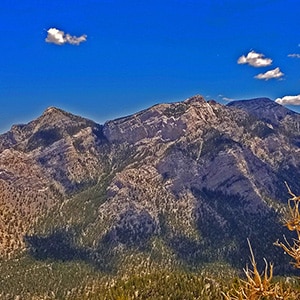
Overview | Mummy’s Head Approach Gully from Lee Canyon Rd | Mt Charleston Wilderness | Spring Mountains, Nevada – Overview
This is an early exploration for an approach route to
Mummy Mountain’s Head (
Mummy’s Nose,
Mummy’s Chin and
Mummy’s Forehead). It begins from a wide parking area on the right side (West) of
Lee Canyon Road about a mile above that road’s intersection with
Deer Creek Road. The value of the adventure is that, due to searching around for a route vs. following a map or guide, I stumbled upon some cool, seldom explored wilderness areas.
Cross to the East side of
Lee Canyon Road, head up
Avalanche Trail Road and continue on that road taking the first left U-turn. Ascend the avalanche slope to the opening between the two visible summit areas where you can turn left (North) or right (South) to either summit.
Directions to Start Point | Mummy’s Head Approach Gully from Lee Canyon Rd | Mt Charleston Wilderness | Spring Mountains, Nevada – Route Starting Point
Take
Hwy 95 North from
Las Vegas for about 10 miles past the residential developments. Turn left onto
Lee Canyon Road (after the
Desert National Wildlife Refuge exit). Begin from a large parking area on the West side of
Lee Canyon Road (Hwy 156) about a mile past its intersection with
Deer Creek Road (Hwy 158).
↓ Narrative Guide ↓
Narrative Guide | Mummy’s Head Approach Gully from Lee Canyon Rd | Mt Charleston Wilderness | Spring Mountains, Nevada – Route Observations
Here follows multiple explorations in search of a great route from Lee Canyon Road to
Mummy Mountain’s Head (
Mummy’s Nose,
Mummy’s Chin and
Mummy’s Forehead). See
Mummy’s Head features in sharp detail.
Second Exploration (Finding the Main – unmarked – Trail to Mummy’s Nose and Forehead
In this adventure I came across the main climber’s path to the saddle between
Mummy’s Nose and
Mummy’s Forehead.
Initial Exploration (A Canyon Wash Too Far South)
This adventure at least introduced me to the area between
Lee Canyon Road and
Mummy Mountain’s Head (
Mummy’s Nose,
Mummy’s Chin and
Mummy’s Forehead), though I believe I was in a canyon wash just one wash South from the better approach route. The images from above around
Sisters North seem to verify that.
From the large parking area on
Lee Canyon Road, head up
Lee Canyon Road about 200ft to the intersection with
Avalanche Trail Road. Take a left onto
Avalanche Trail Road and continue up that road taking the first U-turn to the left (in about 1/8th mile). When confronted by a gate announcing private property, begin to ascend the avalanche slope to the right. So far, this is the way to go to reach
Mummy’s Head. However, instead of heading straight up the avalanche slope as I did on this day, angle left (North) as you begin to ascend.
On this day I headed straight up the avalanche slope gully wash and believe that I ended up faced with rocky ledges above and to the sides. Eventually I returned by a firmer, more stable ridge just South of the gully wash.
Observations along the way while exploring the area at the base of Mummy’s Head:
- This is the most rapid ascent I have found from a trailhead in the Spring Mountains into a largely untouched wilderness area.
- The wilderness area is spectacular with a beautiful pine forest to the backdrop of limestone rock formations, cliffs and ledges.
- However, you can hear the noisy sounds of traffic just below on Lee Canyon Road. This is the only interruption from the natural beauty of the area.
- The terrain soon becomes blocked by ledges ahead and cliffs to either side as the loose rock slope’s incline increases.
- Approach Mummy Mountain’s Head (Mummy’s Nose, Mummy’s Chin and Mummy’s Forehead) either before sunrise or around mid-day. Once the sun tops Mummy’s Head during sunrise you are pretty well blinded and have difficulty picking out the route ahead.
Next time I’ll angle left (North) as I ascend from
Avalanche Trail Road in search of the
Bristlecone Pine forested approach one gully further North. This fits my earlier observations viewed from across
Lee Canyon above near
Sisters North.
This is how I systematically explore a new destination in the wilderness. It takes multiple trips, but by the time I reach the destination I know the entire area along with multiple routes.