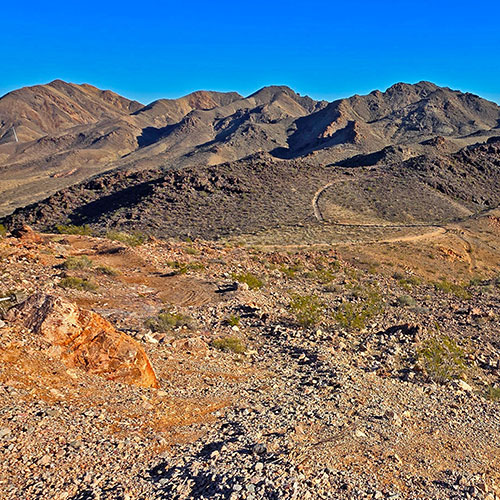
Overview | Black Mountain & River Mountain Loop | River Mountains | Lake Mead NRA, Nevada
This is one of those rare adventures where you can see your entire route from the starting place! Yet, when you’re out there, every moment and every turn presents new discoveries. It’s like viewing a snowflake, then zooming in with an electron microscope to discover the intricate wonders. Watch for weird volcanic formations, arches, a great variety of rocks including geodes, and the massive surrounding geological history including tectonic shifts that formed this rugged terrain. Some of this is explained in the video.
Black Mountain & River Mountain Loop Route Summary
The loop route begins on Bootleg Canyon Road above Boulder City, Nevada and just below that weird Sci-fi VORTAC communications complex the locals refer to as Radar Mountain (more on this below). The peaks you’ll summit are all visible, stretching out in a crescent to the Northeast. They include Black Mountain Overlook, Black Mountain, River Mountain and River Mountain Benchmark, the highest peak in the River Mountains. Your return route, along the River Mountain Basin, stretches out below, to the West, from the base of River Mountain Benchmark Peak back to the starting point where you are standing.
What’s Visible from the Black Mountain & River Mountain Loop?
Then, there’s the spectacular vistas you will see at every moment from this highest ridge in the River Mountains. Here’s a quick summary, moving counterclockwise from Radar Mountain:
And, of course, the River Mountains from this, their highest ridgeline!
How Difficult is the Black Mountain & River Mountain Loop?
While a portion of the adventure is on a very good trail, most of the adventure follows very faint climber’s (human and bighorn) paths. There’s no significant (horrifying vertical) exposure, but there are the expected loose rock, steep volcanic slopes. It’s mostly class 2 with some brief, light class 3 challenges (need to use your hands rock scrambling).
What’s the Best Time of Year for This Loop Adventure?
Stick to late Fall through early Spring. During these months it will feel as if you left Winter and were on a Summer vacation. However, the actual Summer months can bring temperatures can reach dangerously high levels exceeding 120 degrees!
Trailhead directions | Black Mountain & River Mountain Loop | River Mountains | Lake Mead NRA, Nevada
Take I-11 South from Las Vegas. Turn left (East) onto Business Highway 93 toward Boulder City. Turn Left onto Veterans Memorial Dr. Turn Left onto Bootleg Canyon Road (becomes unpaved, but well graded in a mile or so). Take Bootleg Canyon Road to the trailhead.
Narrative Guide | Black Mountain & River Mountain Loop | River Mountains | Lake Mead NRA, Nevada
Getting Your Initial Bearings
From your vantage point in the parking area just below Radar Mountain, take a moment to identify the peaks you will summit (mentioned above), and your route along the return valley below. We took the loop route in a counterclockwise direction. The route appears simple, but when you’re out there, that is a bit more complicated.
You may want to take the short walk up the hill directly above to get a closer look at the Radar Mountain complex, and possibly summit Red Mountain. These are very close, but may take away some of the time you’ll need for the main adventure loop. Perhaps visit these when you’re done with the loop, if you have enough energy left!
About that VORTAC communications facility on Radar Mountain:
VORTAC stands for VHF Omni-directional Range/Tactical Aircraft Control. It’s a type of short-range radio navigation system enabling aircraft to determine their position and stay on course. It’s a navigational aid for aircraft pilots consisting of a co-located VHF omnidirectional range (VOR) beacon and a tactical air navigation system (TACAN) beacon. Both types of beacons provide pilots azimuth (directional) information, but the VOR system is generally used by civil aircraft and the TACAN system by military aircraft. For more VORTAC detail than you might need, follow this link.
Parking Area to Black Mountain Overlook Peak
The route to Black Mountain Overlook is the easiest part of this adventure. It’s on the wide, well-marked Black Mountain Overlook trail. Your access to the trail begins at the parking area, descending to the saddle toward Black Mountain Overlook, then ascending to its summit. Note another good trail ascending from Boulder City to the saddle, crossing the saddle, then descending to the valley to the West. That’s another great future adventure!
During this stretch, also note the weird and fantastic volcanic formations including cave-like lava bubbles, fissures and arches. It’s like toothpaste squeezed from a tube, in this case the center of the earth, then frozen in time.
Black Mountain Overlook itself is a great platform with a spectacular surrounding views (see the above list) surpassed only by the peaks you will soon summit. Note especially the views toward Lake Mead, Fortification Hill, the Black Mountains and Mt. Wilson. These views will become more expansive as you continue along the loop, and the lighting will cause them to stand out more clearly as the sun advances during the day. If you only take the short hike to Black Mountain Overlook, it’s well worthwhile. There’s a nice resting bench on that summit, along with two very informative interpretive displays on the region’s geological history (see the slide guide above and the video).
Black Mountain Overlook to Black Mountain
From Black Mountain Overlook, you can see Black Mountain and the intervening saddle below. Here is where the good trail ends and you begin traversing faint climber’s pathways. The slope to the saddle is steep, with a loose volcanic rock surface. Get used to it! This is the terrain you will experience all the way to River Mountain Benchmark, the final peak, then down to the return valley below that peak. The route strategy is to stay high along the outer edge of the loop, just above where the cliff drops off to your right. Navigate around intervening rocky formations to the left but close to their summit. Basically, stay as high as you can along the loop, just above where the cliff drops off to your right, always giving yourself about 6 feet of space between you and the drop-off.
Down in the saddle, the view of Black Mountain will disappear, and you’ll discover there is a smaller intervening peak to summit along the way. Black Mountain itself presents an even more expansive view of the surrounding terrain. In particular, nearly all of Lake Mead is now visible, and the view back to that Sci-fi looking Radar Mountain VORTAC communications complex is at its best. The lighting is getting better as, by now, the sun is not directly above these views. It will get even better as you top River Mountain and River Mountain Benchmark.
Black Mountain to River Mountain
Strangely, the terrain to the next peak always looks impossibly steep and vertical. However, note that when you look back at the previous peak from which you just came, that terrain also looks impossibly steep and vertical! When you’re actually navigating the stretch between the peaks, there are steep loose rock stretches, but it’s easier than it looks from a distance. Take it step-by-step. A way will always open up before you. And note that there are a few nice descent slopes along the way to the left to the valley below. The most significant descent route is down the powerline maintenance road from the saddle between River Mountain and River Mountain Benchmark. You probably won’t need to take any of these early escape routes, but it’s good to know they are there.
Once on River Mountain summit, the views to Lake Mead below and to the North and East have dramatically expanded.
River Mountain to River Mountain Benchmark
There’s a significant high point to summit between River Mountain and River Mountain Benchmark. Of course, there are deep saddles between all today’s high points. This intervening high point, in particular, is a long, fairly level summit area. You’ll descend from that area to the next saddle directly below River Mountain Benchmark. This is where the powerlines from Hoover Dam cross and where there’s a maintenance road leading downward to the left. Cross this saddle and navigate the steep slope to the Northeastern end of River Mountain Benchmark. You’re ascending a steep slope, hugging the upper left edge of a deep gully. Here’s where you know you’re a pathway created by bighorn sheep…we call it the Bighorn Sheep Express.
River Mountain Benchmark is a long summit area with a Northeast and Southwest high point and a saddle between. Work you way angling to the right to the Northeast summit, then cross the saddle to the Southwest, true summit with the summit box. Both summits have unique views. The Northeast summit has the best views of Lake Mead and surrounding reference points beyond along with most of the River Mountains. The Southwest summit has the best views of Las Vegas Valley and the Strip, and the surrounding mountains to the North and West from the Sheep Range to the entire stretch of the Spring Mountains to Henderson with a backdrop of the McCullough Hills, then the Railroad Mountains, Eldorado Wilderness and back to Radar Mountain.
River Mountain Benchmark to the Return Valley Below
There are two main descent routes from River Mountain Benchmark to the return valley. The steeper descent slope directly to the valley below is to the Southwest. There’s a more gradual descent slope to the West, where you can then circle around to the return valley. The gradual slope is a longer distance, but not much longer. You’ll cover that stretch more rapidly because it’s not as steep. The steep slope is shorter, but the distance saved may end up taking the same amount of time.
We took the more gradual descent slope, then, about half-way down the slope angled downward to the gully below, taking that wash to its base, then circling back toward the starting point. Weaving around and among the huge, water-smoothed boulders in the gully presented a nice variety of terrain from the upper slopes. There were no dry-fall barriers in the gully. With its greenery, the gully seemed like another world from the stark more barren slopes above.
Return Valley to the Starting Point
As you near the base of the gully, the view of Radar Mountain and your starting point will emerge. Now it’s just a matter of crossing the intervening valley. The valley crossing involves crossing a few gullies descending from the ridgeline above to the left. The intervening gullies higher along the base of the ridgeline are a bit more shallow and easy to cross. There is also a network of trails that will aid your progress through the valley. Remember the nice Black Mountain Overlook Trail at the beginning of the loop? It runs along the saddle between the parking area and Black Mountain Overlook. You want to ascend to that saddle where you can connect with the trail, then return to your starting point. There are a few gullies that ascend to that saddle. Pick one of these options. You know you’ll end up on the Black Mountain Overlook Trail. We selected the gully that contained that trail pointed out earlier–the trail beginning in Boulder City, crossing the saddle, then descending to the West through the valley.
All the return route choices are equally good. Crossing the valley in the late afternoon-early evening sunset presents beautiful views!
Summary of the Black Mountain & River Mountain Loop
Congratulations! You’ve just experienced one of the most comprehensive reviews of the vast volcanic area to the South and East of Las Vegas. This volcanic terrain, when active, would have proudly stood alongside many famous lava fields in the U.S. stretch of the Ring of Fire including Yellowstone, Lassen, and the Cascade Mountains in the Pacific Northwest. You’ve traversed a stretch of ancient fiery ground between the North American and Pacific Plates. This volcanic activity separated continents!