Overview | Mohave Overlook Loop | Eldorado Wilderness, Nevada
The Mohave Overlook provides a spectacular view of the rugged, largely untouched Eldorado Wilderness all the way to the Colorado River.
Vehicle Approach to the Mohave Overlook
You could drive the unpaved, recommended high center vehicle approach road all the way from Highway 95 to the Mohave Overlook. Take wilderness road “E”, then “F” to reach the overlook. See the purple route on the map on this page.
Higher, Even More Spectacular Mohave Overlook Loop on Foot
This adventure (blue route on the map) documents a 12-mile loop route with even higher, more spectacular views of the Eldorado Wilderness and the Colorado River all the way to Lake Mohave! Yet, the entire loop is an easy class 2 walk (except for the distance) with just one short but steep slope to descend.
Mohave Overlook Loop Route Summary
Beginning on Nelson Highway 165 just South of Las Vegas, you’ll cross a beautiful volcanic desert, then ascend the approach ridgeline to a mesa I call The Lonesome Wash Overlook Mesa. The less attractive official name is “Peak 3420” denoting its elevation. It’s actually a long flat mesa, and from its summit you can look down on most of the length of Lonesome Wash below, across to Lonesome Peak and North Lonesome Peak, over to the Colorado River all the way to Lake Mohave, and down to Mohave Overlook below. Descend the Lonesome Wash Overlook Mesa to the official Mohave Overlook, not as high but very spectacular. Then descend wilderness Road “F” for about a mile, finally looping around two low ridges and back to your starting point on Highway 165.
Views from the Mohave Overlook Loop
In addition to the reference points above, here is a short list of the views you will take in during this spectacular loop (views listed clockwise):
- McCullough Mountain in the South McCullough Wilderness
- Black Mountain and the North McCullough Wilderness
- Railroad Mountains
- Boulder City with a Backdrop of the River Mountains
- Pilot Cone & Pilot Mesa
- Peeper Benchmark Peak
- Forlorn Hope Peak
- Peaks 3340 & 3510
- Lonesome Peak
- North Lonesome Peak
- Lonesome Peak’s West and East Canyons
- Lonesome Wash (nearly the entire length to the Colorado River)
- Lonesome Wash Overlook Mesa
- Nelson Hills
This is a non-stop spectacular view route!
Best Time of Year for the Mohave Overlook Loop
If you’re taking the 12-mile loop on foot, stick to late Fall through early Spring. Summer brings dangerously high temperatures that can reach and exceed 120 degrees!
Trailhead Directions | Mohave Overlook Loop | Eldorado Wilderness, Nevada
The Eldorado Wilderness is South of Las Vegas. Take Interstate 11 South toward Hoover Dam. Just after the Railroad Pass exit, take a right onto exit 14 to Hwy 95 toward Searchlight. Then, take a left onto Hwy 165. You’ll soon see well-placed, attractive interpretive signs for the Eldorado Wilderness and Nelson Hills. There is an Eldorado Trailhead, but you want to park at a wide spot by the road a couple miles before the trailhead.
Narrative Guide | Mohave Overlook Loop | Eldorado Wilderness, Nevada
Getting Your Initial Bearings
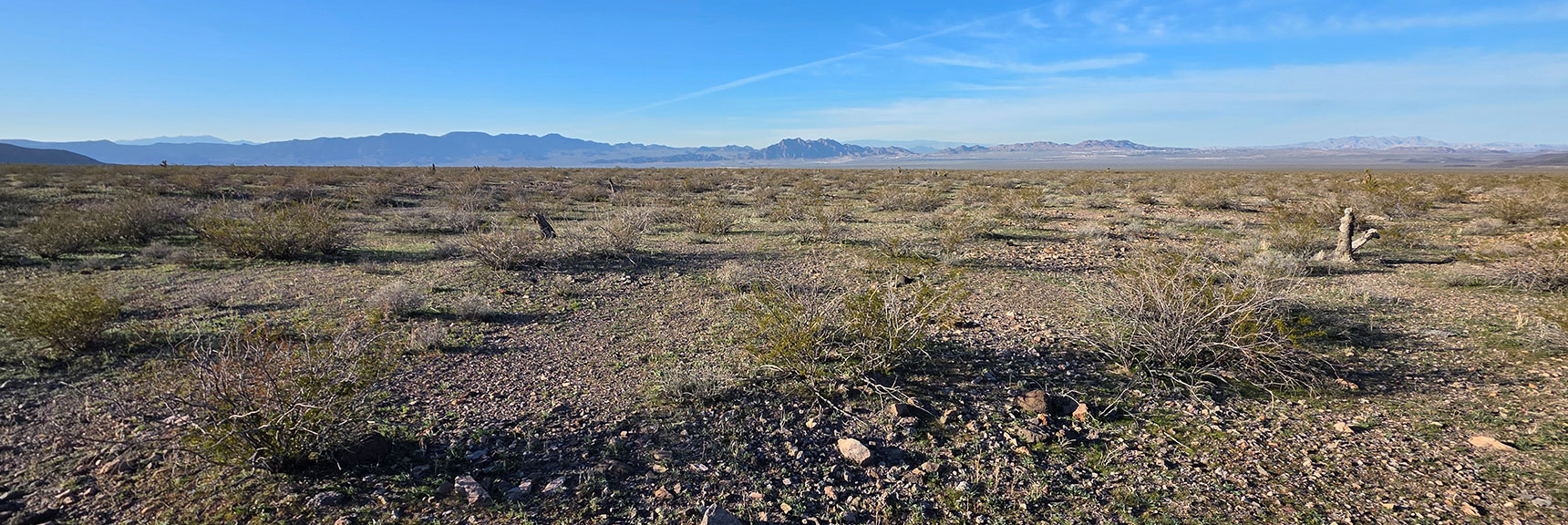
The reference points you can see from the starting point on Highway 165 will help guide you through most of the Mohave Overlook Loop. To the North, across Highway 195 is a long ridgeline. From left to right there are the South McCullough Wilderness, North McCullough Wilderness, Railroad Mountains and River Mountains with Boulder City at their base. To the East is a long ridgeline with a gradual ascent from the desert floor at its North (left) end to a high point at the South (right) end. That high point is the Lonesome Wash Overlook Mesa (Peak 3420). To the South you might be able to make out Lonesome Peak, high point of the Eldorado Wilderness. Behind you to the Northwest are the Nelson Hills.
Highway 165 to the Lonesome Wash Overlook Mesa Approach Ridge
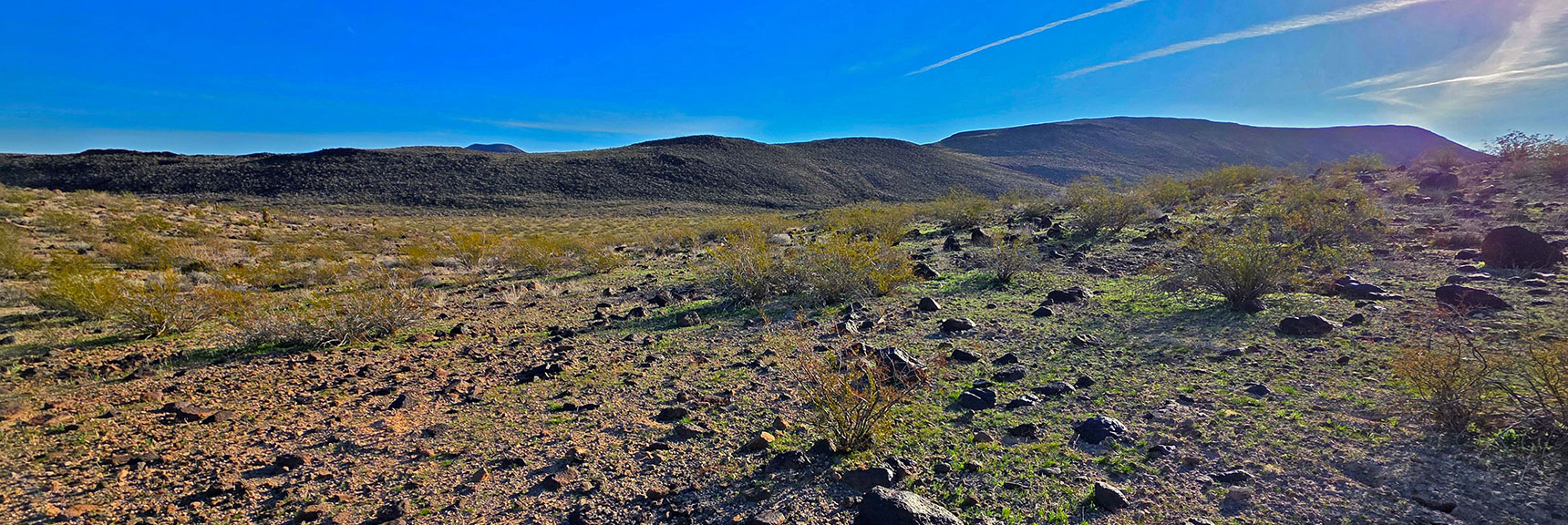
Begin by heading East across to open desert for a mile to a low point on the Lonesome Wash Overlook Mesa approach ridgeline. Some experience the open desert as boring. It’s actually a peaceful, magical place! There are wide-open views of the mountains to the North, brilliantly painted by the morning sunrise. Notice all the volcanic boulders scattered around throughout this desert mile. Imagine these at one time falling from the sky during a volcanic eruption to rest in the exact place you see them. Though you can clearly see Boulder City, you’re invisible in plain sight to the eyes of its inhabitants…and to any other humans anywhere in the distance. It’s an amazing experience once you begin to take it in!
Lonesome Wash Overlook Mesa Approach Ridge to the South Edge of the Mesa
Ascend the short slope to the Lonesome Wash Overlook Mesa approach ridge. If you turned right along the base of that slope you’d reach the upper entrance of Lonesome Wash. I haven’t yet descended into Lonesome Wash, but from above, the initial descent looks steep and complicated. Today, you’ll ascend the Lonesome Wash Overlook Ridge instead.
The Lonesome Wash Overlook Ridge is about a half-mile long, gradual and scattered with large volcanic boulders and piles of boulders. You can easily weave around the boulders. I kept to the upper West edge of the approach ridge in order to study the route below to Lonesome Wash. You’ll know when you reach the summit of the Lonesome Wash Overlook Mesa. You can only angle to the left (North) along the upper edge of the Mesa overlooking Lonesome Wash below, Lonesome Peak & North Lonesome Peak to the South and the canyons on either side of their long ridgeline.
North Edge to South Edge of the Lonesome Wash Overlook Mesa
As I started along the upper North edge of the Lonesome Wash Overlook Mesa (remember official name is Peak 3420), I was obsessed with the idea of potential descent points into the Lonesome Wash below. The upper end of Lonesome Wash was clearly visible, and looked possible by navigating some steep slopes, narrow gullies and some class 3 rock scrambles. However, there may be some vertical barriers that cannot be bypassed down there. Once you get into the wash, it looks like an easy wide-open gradual traverse all the way to the Colorado River. But that final descent to the Colorado River at the lower end of the wash is not visible and may present some barriers similar to lower Goldstrike Canyon as it approaches the Colorado River. A surprising discovery was a few descent points over the edge of the Lonesome Wash Overlook Mesa and down into Lonesome Wash below. From a distance the South edge of the Mesa looks impossibly vertical (see the 2nd slide above). However, when you’re above, looking over the edge, it looks possible without exceeding class 3 rock scrambling! No guarantees, I haven’t tried it yet!
The Mesa view is incredible! As you approach the South edge of the Mesa, more of the Colorado River comes into sight…all the way to Lake Mohave. You can’t see Lake Mohave from the Mohave Overlook, but you can see it from the high Lonesome Wash Overlook Mesa. Go all the way to the very South edge of the Mesa for the best views. There you will also be able to make out the Mohave Overlook, far below, along with unique expansive views of the Eldorado Wilderness all around.
South Edge of the Lonesome Wash Overlook Mesa to the Mohave Overlook
Once on the South edge of the Lonesome Wash Overlook Mesa, circle back to the North to descend along the Mesa’s East ridgeline. Watch for Road “F” below to the East, knowing that it marks the location of the Mohave Overlook at its upper (right) end. You’ll see a point where you need to descend the steepest slope of the day, then navigate a short valley between some hills toward Road “F” and the Mohave Overlook. The huge volcanic boulders on that steep slope make great steps as you weave downward to the approach valley below. Just be sure that any boulder you place your foot upon is secure! Most are. The steep slope is not too long and you’ll reach the bottom before you know it!
Once at the base of the slope, you might be able to make out a faint trail leading through the valley between the hills toward the Mohave Overlook. You can no longer see the overlook, so you will need to have identified its location and approach carefully from above. The distance from the base of the slope to the Mohave Overlook is less than a half-mile.
The final hills on your right, just before Road “F”, lead up to the Mohave Overlook, which is actually a short ridgeline. Ascend the hills until you reach their edge above Lonesome Wash. Here the views are spectacular! You can not only see the length of the Colorado River, now a brilliant blue, but there’s the White Hills Wind Farm wind turbines rotating across the Colorado River in Arizona. Forlorn Peak and Peeper Benchmark Peak are prominent in the foreground. The upper end of Road “F” is directly below, less than 30 feet away.
Road “F” to the Start Point on Highway 165
Now head about a mile down Road “F” until you reach the base of Peeper Benchmark Peek to your right and the edge of a high ridge to your left. Turn left at this point to round the lower edge of the high ridge toward your starting point on Highway 165. At times, Black Mountain, the Railroad Mountains and River Mountains appear to the North (your right). You’re traversing a route parallel to these as you head West toward Highway 165. There are a couple low ridges to cross. Once at the summit of the final ridge (actually the original ascent ridge you took to Lonesome Wash Overlook Mesa), the hills that mark your parking spot on Highway 165 pop into view to the West. There’s a short, pointed hill just to the left of the hills. Let this be your guiding reference. You car is parked on Highway 165 at a point in direct alignment with that hill.
Conclusion
Congratulations on completing this 12-mile loop with its non-stop intoxicating views! What a day of total wilderness immersion! And along the way you will have scoped out many future adventures in the rugged, majestic Eldorado Wilderness.
By the way, don’t fail to recognize the journey you’ve made through history today. As you walked across ancient volcanic fields, you’re engaged in the most ancient form of energy…muscle propulsion. As you drove to the starting point you were propelled by fossil fuel energy (19th & 20th century). The Colorado River is the power base (Hoover Dam) for much of the hydroelectric energy of the Southwest (20th century to present energy source), along with the water supply. Those volcanic fields signify the thermal energy below. At the base of the McCullough Hills there was a large solar farm. Across from the Mohave Overlook, in Arizona, there was a large wind farm. These are the future of energy. These signify energy into the future.
But that’s not all: You’ve traversed the history of wealth. You were literally walking on gold dust (the core meaning of “Eldorado”). That’s one of the most ancient forms of wealth. In your wallet you had currency, a later form of wealth. And also, in your wallet you carried a charge card…electronic form of wealth pointing to the future!